
This report provides a summary of the main lessons learnt from all ENSMOV Plus’ resources and activities, following the three main stages of the policy cycle, in the context of Member States’ energy savings obligation (Article 8 of the Energy Efficiency Directive EU/2023/1791):
Policy design and implementation (cf. chapter 2); Monitoring and verification (cf. chapter 3); and Evaluation (cf. chapter 4).
The report concludes with a forward-looking chapter 5, discussing factors that may influence possible re-design of energy efficiency policy measures.
27 examples addressed six key topics selected from a stakeholder survey:
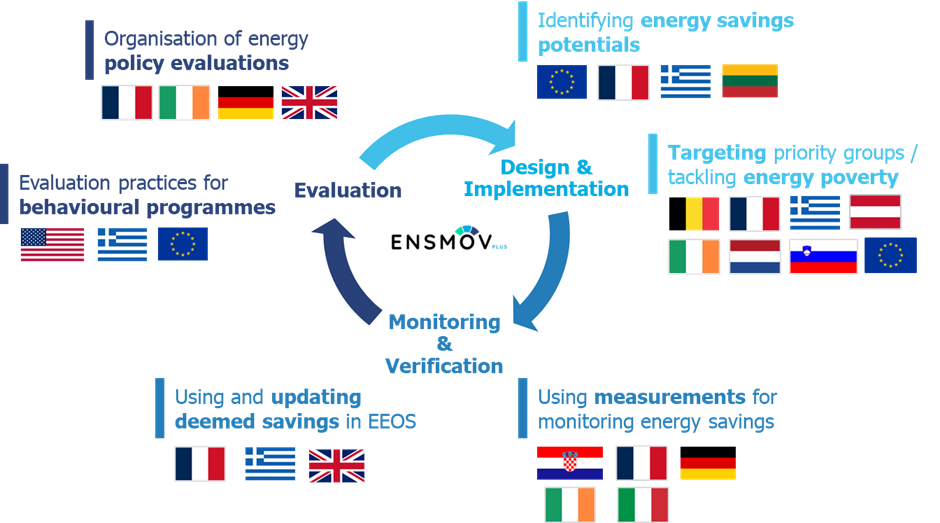
The topics above were complemented with further exchanges and analyses:
- Modelling of residential building stocks and bottom–up assessments to inform strategic allocation of funds for maximising impacts.
- Targeted review of Energy Efficiency Obligation Schemes (EEOSs) focused on the use of substitution fees.
- Feasibility of an EU-wide energy savings certification scheme.
- A review of transport measures, complemented with discussions on the case of support schemes for electric vehicles (EVs).
- Recommendations on Monitoring, Reporting and Verification (MRV) practices.
- Supporting the assessment of multiple impacts of energy efficiency measures.
The report concludes with discussing two major topics that should be increasingly considered in the design of future energy efficiency policies: electrification and affordability.